“Stories are the closest we can come to shared experience…Like all stories, they are most fundamentally a chance to ride around inside another head and be reminded that being who we are and where we are, and doing what we’re doing, is not the only possibility.”
– Harriet McBryde Johnson, Too Late to Die Young: Nearly True Tales from a Life
It is but human to be touched by stories. But what if one could touch the stories instead? Dr Namita Jacob, founder of Chetana Charitable Trust, together with a team of talented and driven volunteers, striving towards making stories and learning accessible to the children of the dead-blind community for the past 8 years, has made this possible through tactile art.
Chetana Charitable Trust was founded in 2006 to provide skill training to children with multiple disabilities. The Trust moved a step ahead and decided that a greater exposure to the world outside needs to be given to its children. The tactile library, established in 2016, was put together for this purpose to instil in the younger learners an interest in reading. Books with various shapes cut out of a variety of materials and textures, books in spaced-out Braille scripts, and books with stories from the city and from around the world fill the shelves of Chetana Charitable Trust’s tactile library.
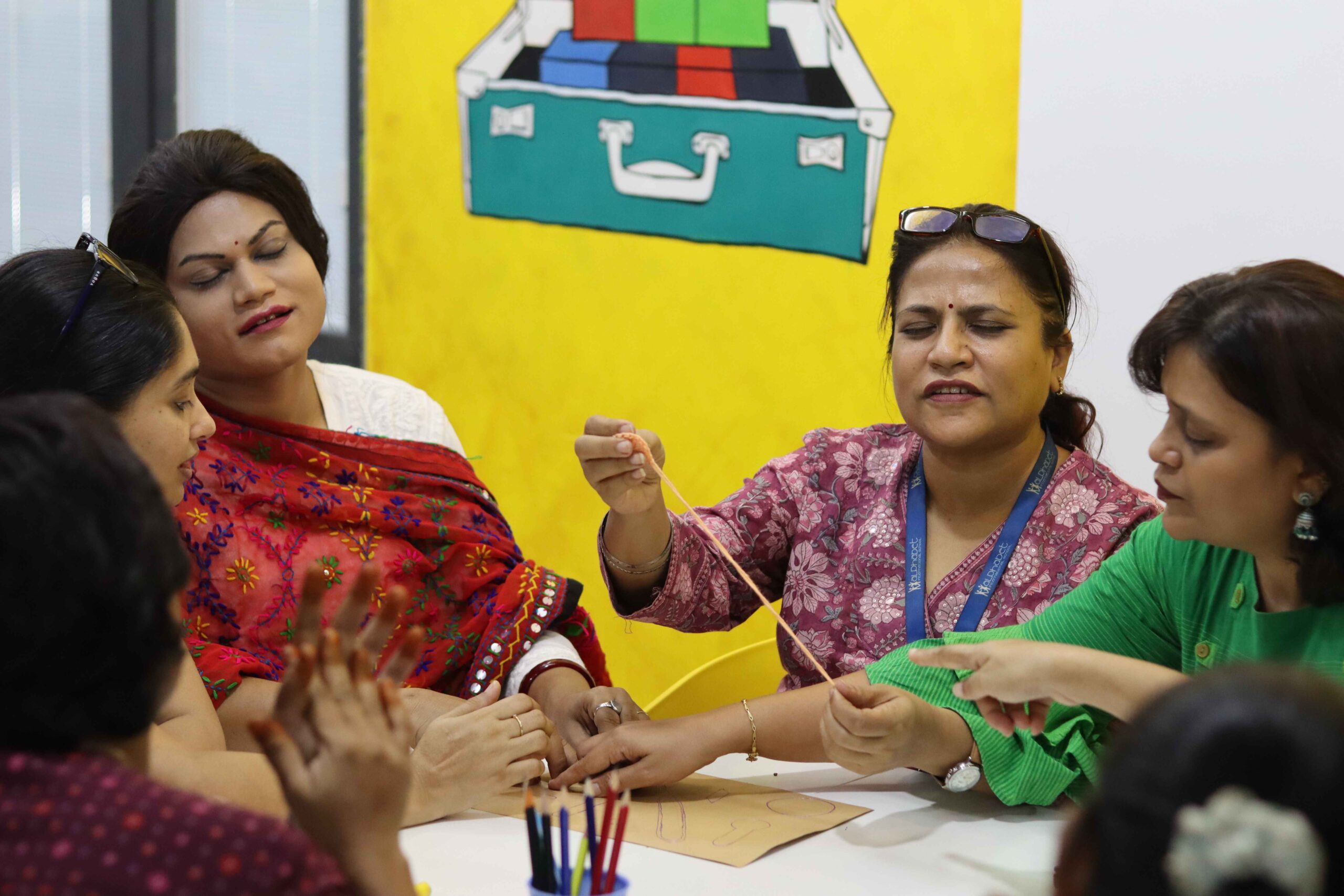
As part of their efforts to equip educators with the skills to teach students with multiple disabilities, the Trust organises workshops on learning strategies and creating tactile art to make reading a more visceral experience for the deafblind community. The teachers of aLphabet internationaL schooL had the opportunity to attend one such workshop moderated by Dr Namita and our PYP Coordinator Ms Minu. Dr Namita presented how the Trust has been working with the deafblind community for many years, reaching out to individuals. To get a firsthand look at the working of tactile books, the teachers participated in activities that focussed on the tactile sensation to understand the significance of learning through touch. The workshop included an art component for which all the teachers made individual tactile postcards using strips of different materials. The postcards were made for deafblind students who could use them for their learning. Teachers were encouraged to explore as many materials as possible for creating a final product that would incorporate multiple textures for someone. The workshop also highlighted some of the major milestones achieved by the people of the deafblind community to emphasise on their ability to take up agency for their lives.
Following is a deep dive into the how and why the Trust came to be, and how it strives to redefine the way education for the disabled community is perceived, in the founder’s own words (the language has been sparsely edited for clarity only):
Q1. What motivated you to approach the framework of education from the vantage point of disability?
Ans. I think learning—learning has always been interesting. Especially when you meet people who learn differently, and you are trying to help them perceive something, come to your point of view, you really have to learn how they learn differently. Personality is one thing , but just at a more fundamental level if one experiences the world differently then that is really exciting; and I think in understanding that, and in understanding a person who perceives the world differently has helped me to see the power of difference in numerous different settings. For example, if I were to walk in my campus amongst numerous birds and the trees it would be wonderful. I see and hear a lot of wonderful things. When my friend who is deaf and blind comes to stay with me on campus, and we walk the same road, he says that he loves to walk on campus. I ask him why and he says that the air changes. He is right, the air is warm or cool; it is not just the smell. I have never consciously noticed that before, but now that he said it I can never ignore it—even on our horrible city roads the air changes! So that is the reason for such an interest. If one pays attention to how one sees the world, it creates an opportunity for two people to be on the same side of a discussion, while they expand the view of the world for each other.
Q2. Taking a cue from the note of differences that you emphasised upon, would you also like to express your views about the similarities that you have noticed between you and the deafblind community?
Ans. Yes, we are fundamentally people. We have the same motivation, same desires, same fears. I think it is a given that they are people with their unique personalities. But despite the similarities, there are surprising differences which I have always found awesome.
Q3. How did your association with aLphabet internationaL come to be?
Ans. Seven years ago I gave a talk at the Stella Maris College Chennai, for the Visual Arts program on the topic, “Illustration for the Blind”. I had carried with me the books that we had created at Chetana to show them to the students. At the end of the program, I presented them with a national opportunity to create books for children who are blind or have low vision. About nine of them had signed up. It sparked a semester-long interaction with them, and out of that bunch, one of the girls reached out to me again saying that she wanted to do a similar project for her graduation project. Her faculty did not see it as art, but she wanted to work on it, and she told her faculty that she wanted me as her mentor. That began my relationship with Teresa Anthony. After graduation, Teresa arrived at my doorstep saying that she wanted to work for me. I told her that the Trust does not hire anyone as an employee, but works only with volunteers. I suggested to her that she can work with us part-time. Then she joined aLphabet as an art teacher for the junior school, and every day after finishing her work at the school she would come to my office to volunteer. After about two months I decided to hire her as an employee after a year to give her the required time to fulfil her commitments towards the school. She approached Ms. Kavita regarding this and told her that she would work at aLphabet for about a year because she wished to join the Trust. Ms. Kavita encouraged her passion and allowed her to leave at the end of the term. Ms. Kavita has always encouraged such a passion instead of crushing it as a headmistress. From then on, I have known that this school welcomes multiple ways of thinking and learning for the students. Since then we have conducted multiple workshops with the students, and this time we had the opportunity to work with the teachers.
Q4. How was your experience conducting the workshop for the Deafblind Awareness week with the teachers of aLphabet this time?
Ans. I loved it! With teachers, it is always uncertain for one. One never knows how adult teachers would treat such a workshop. But what I found was lovely. I think people entered the activities with interest, curiosity, and openness. I found wonderful reflections, questions, ideas and thoughtful discussions. They instinctively connected the workshop with student learning and classroom experiences. I could see that many ideas were taking roots in classroom plans. I found it lovely that all the teachers worked together, and had the opportunity to interact with some of the teachers individually. I am excited to see what will come of this day. I hope children will find more avenues for their learning from hereon.
Q5. What message would you like to leave our readers with?
Ans. I think I have been very lucky. The kids I had taught are my colleagues today. I continue to learn from them like a good teacher. I think when people ask me what I did and studied, somehow it sounds like a straight line. But now in retrospection, I realise that many times it was not my decision or my understanding. I remember my decision to work with the Deafblind group was stupid. I already had the experience of working with children having intellectual disabilities. I had learnt about the blind and the deaf. Then I met this Parsi woman, who asked me to come and teach the deaf and blind community. I entered into it with a complete lack of understanding. But the good thing was that it was brilliant, and somehow tailored for me. None of my decisions were well-thought-out plans. So my message is to follow your way without overthinking stuff. Stay interested, and just trust. There is learning in the most unusual places and positions!