Life @ ais- Founder’s vision

From the Head’s desk

The Founder’s Vision

No education is complete without a vision driving it forward. To provide a holistic education which not only prepares one to earn a livelihood but also to learn to live a purposeful life is the primary impetus for the working of an educational institution. With the same drive, aLphabet internationaL was established: to create students of life with a “yearning for learning.”

aLphabet internationaL was founded with the vision to create a stimulating environment to not just bring out the untapped potential of students but also guide them towards harnessing that potential to make meaningful contributions to the world. With a comprehensive set of values as lodestars for students to follow, the school aims to create active, compassionate, lifelong learners; the key set of values being:

  • Excellence: Striving for the highest standards in academic achievement, personal development, and community engagement.
  • Empathy: Showing compassion and understanding towards others, fostering kindness and support within the school community.
  • Inclusivity: Creating a welcoming and supportive environment where diversity is celebrated and everyone feels valued and included.
  • Balanced: Understanding the importance of intellectual, physical, and emotional well-being to achieve personal growth.
  • Responsibility: Taking ownership of one’s actions, commitments, and contributions to the school and wider community.
  • Collaboration: Working together cooperatively and effectively, fostering teamwork and shared goals among students, staff, and parents.

With international mindedness and respect for diversity of cultures built into its curriculum, the school strives to inculcate in its students a sense of community along with acceptance of differences instead of mere tolerance in order for them to become socially aware individuals who would counter the divisiveness in the world.

With the 15th academic year of aLphabet internationaL schooL underway, I want to extend my heartfelt wishes to each of you. This year holds the promise of exciting opportunities for learning, personal growth, and collective achievement. To our dedicated teachers: Your passion and commitment are the bedrock of our school. Your unwavering dedication to guiding and inspiring our students is truly commendable. Your hard work, innovative teaching methods, and nurturing approach make a profound difference in their lives and shape their future paths.

To our enthusiastic students: You are the heart of our school community. Each of you brings unique talents, perspectives, and aspirations. Embrace each day with curiosity and determination. Seize every chance to explore, learn, and evolve into the exceptional individuals you are destined to become. Your journey of discovery and growth is what drives us forward as educators.

Together, let us embark on this journey with a spirit of collaboration, respect, and excellence. As we navigate the year ahead, let’s support one another, celebrate achievements big and small, and foster a community where everyone feels valued and empowered.

Chetana Foundation

Stories are the closest we can come to shared experience…Like all stories, they are most fundamentally a chance to ride around inside another head and be reminded that being who we are and where we are, and doing what we’re doing, is not the only possibility.”

Harriet McBryde Johnson, Too Late to Die Young: Nearly True Tales from a Life

It is but human to be touched by stories. But what if one could touch the stories instead? Dr Namita Jacob, founder of Chetana Charitable Trust, together with a team of talented and driven volunteers, striving towards making stories and learning accessible to the children of the dead-blind community for the past 8 years, has made this possible through tactile art.

Chetana Charitable Trust was founded in 2006 to provide skill training to children with multiple disabilities. The Trust moved a step ahead and decided that a greater exposure to the world outside needs to be given to its children. The tactile library, established in 2016, was put together for this purpose to instil in the younger learners an interest in reading. Books with various shapes cut out of a variety of materials and textures, books in spaced-out Braille scripts, and books with stories from the city and from around the world fill the shelves of Chetana Charitable Trust’s tactile library.

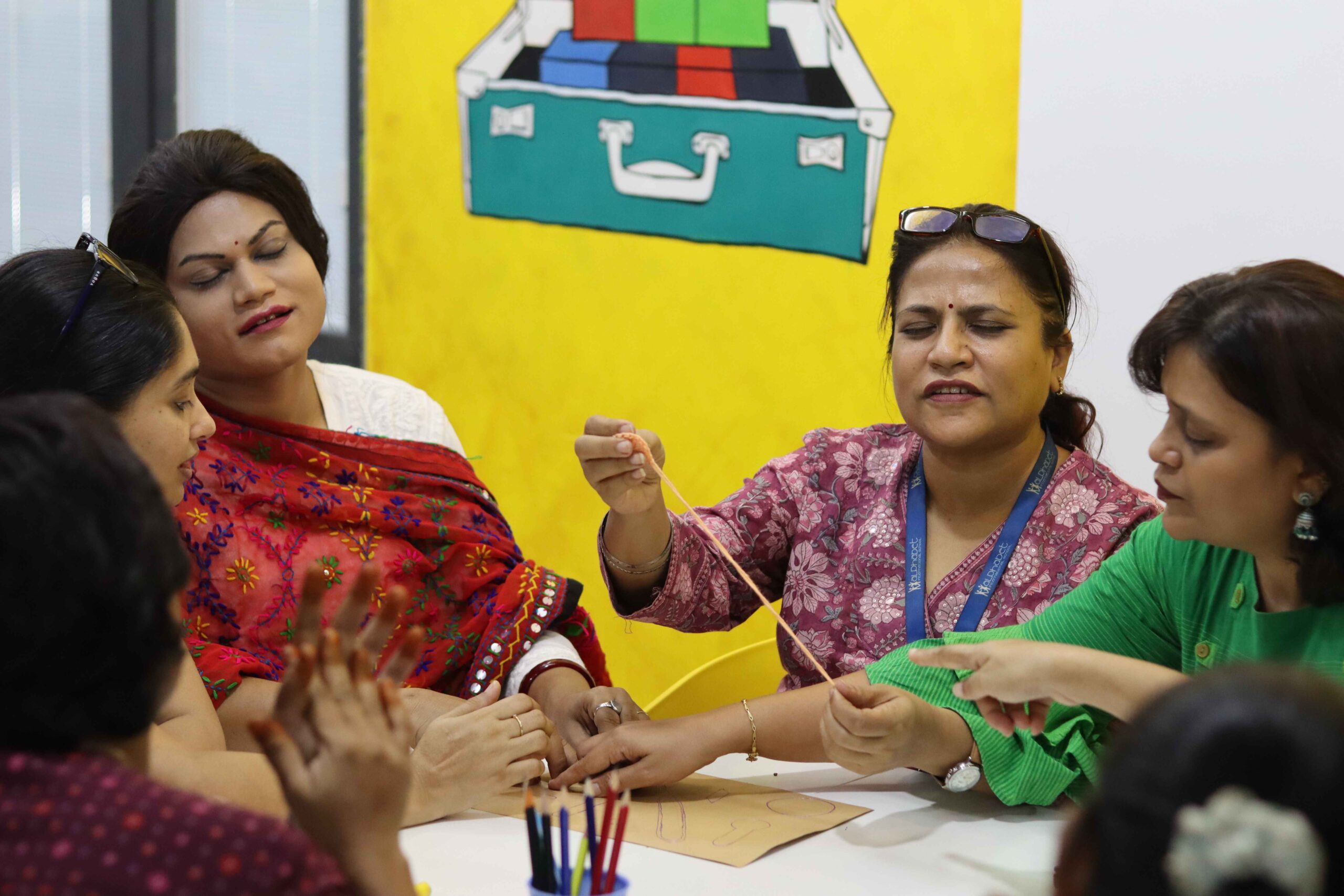
As part of their efforts to equip educators with the skills to teach students with multiple disabilities, the Trust organises workshops on learning strategies and creating tactile art to make reading a more visceral experience for the deafblind community. The teachers of aLphabet internationaL schooL had the opportunity to attend one such workshop moderated by Dr Namita and our PYP Coordinator Ms Minu. Dr Namita presented how the Trust has been working with the deafblind community for many years, reaching out to individuals. To get a firsthand look at the working of tactile books, the teachers participated in activities that focussed on the tactile sensation to understand the significance of learning through touch. The workshop included an art component for which all the teachers made individual tactile postcards using strips of different materials. The postcards were made for deafblind students who could use them for their learning. Teachers were encouraged to explore as many materials as possible for creating a final product that would incorporate multiple textures for someone. The workshop also highlighted some of the major milestones achieved by the people of the deafblind community to emphasise on their ability to take up agency for their lives.

Following is a deep dive into the how and why the Trust came to be, and how it strives to redefine the way education for the disabled community is perceived, in the founder’s own words (the language has been sparsely edited for clarity only):

Q1. What motivated you to approach the framework of education from the vantage point of disability?

Ans. I think learning—learning has always been interesting. Especially when you meet people who learn differently, and you are trying to help them perceive something, come to your point of view, you really have to learn how they learn differently. Personality is one thing , but just at a more fundamental level if one experiences the world differently then that is really exciting; and I think in understanding that, and in understanding a person who perceives the world differently has helped me to see the power of difference in numerous different settings. For example, if I were to walk in my campus amongst numerous birds and the trees it would be wonderful. I see and hear a lot of wonderful things. When my friend who is deaf and blind comes to stay with me on campus, and we walk the same road, he says that he loves to walk on campus. I ask him why and he says that the air changes. He is right, the air is warm or cool; it is not just the smell. I have never consciously noticed that before, but now that he said it I can never ignore it—even on our horrible city roads the air changes! So that is the reason for such an interest. If one pays attention to how one sees the world, it creates an opportunity for two people to be on the same side of a discussion, while they expand the view of the world for each other.

Q2. Taking a cue from the note of differences that you emphasised upon, would you also like to express your views about the similarities that you have noticed between you and the deafblind community?

Ans. Yes, we are fundamentally people. We have the same motivation, same desires, same fears. I think it is a given that they are people with their unique personalities. But despite the similarities, there are surprising differences which I have always found awesome.

Q3. How did your association with aLphabet internationaL come to be?

Ans. Seven years ago I gave a talk at the Stella Maris College Chennai, for the Visual Arts program on the topic, “Illustration for the Blind”. I had carried with me the books that we had created at Chetana to show them to the students. At the end of the program, I presented them with a national opportunity to create books for children who are blind or have low vision. About nine of them had signed up. It sparked a semester-long interaction with them, and out of that bunch, one of the girls reached out to me again saying that she wanted to do a similar project for her graduation project. Her faculty did not see it as art, but she wanted to work on it, and she told her faculty that she wanted me as her mentor. That began my relationship with Teresa Anthony. After graduation, Teresa arrived at my doorstep saying that she wanted to work for me. I told her that the Trust does not hire anyone as an employee, but works only with volunteers. I suggested to her that she can work with us part-time. Then she joined aLphabet as an art teacher for the junior school, and every day after finishing her work at the school she would come to my office to volunteer. After about two months I decided to hire her as an employee after a year to give her the required time to fulfil her commitments towards the school. She approached Ms. Kavita regarding this and told her that she would work at aLphabet for about a year because she wished to join the Trust. Ms. Kavita encouraged her passion and allowed her to leave at the end of the term. Ms. Kavita has always encouraged such a passion instead of crushing it as a headmistress. From then on, I have known that this school welcomes multiple ways of thinking and learning for the students. Since then we have conducted multiple workshops with the students, and this time we had the opportunity to work with the teachers.

Q4. How was your experience conducting the workshop for the Deafblind Awareness week with the teachers of aLphabet this time?

Ans. I loved it! With teachers, it is always uncertain for one. One never knows how adult teachers would treat such a workshop. But what I found was lovely. I think people entered the activities with interest, curiosity, and openness. I found wonderful reflections, questions, ideas and thoughtful discussions. They instinctively connected the workshop with student learning and classroom experiences. I could see that many ideas were taking roots in classroom plans. I found it lovely that all the teachers worked together, and had the opportunity to interact with some of the teachers individually. I am excited to see what will come of this day. I hope children will find more avenues for their learning from hereon.

Q5. What message would you like to leave our readers with?

Ans. I think I have been very lucky. The kids I had taught are my colleagues today. I continue to learn from them like a good teacher. I think when people ask me what I did and studied, somehow it sounds like a straight line. But now in retrospection, I realise that many times it was not my decision or my understanding. I remember my decision to work with the Deafblind group was stupid. I already had the experience of working with children having intellectual disabilities. I had learnt about the blind and the deaf. Then I met this Parsi woman, who asked me to come and teach the deaf and blind community. I entered into it with a complete lack of understanding. But the good thing was that it was brilliant, and somehow tailored for me. None of my decisions were well-thought-out plans. So my message is to follow your way without overthinking stuff. Stay interested, and just trust. There is learning in the most unusual places and positions!
Carpe Diem: Seizing Senior Year’s Opportunities

A Guide to Making the best out of your final year at aLphabet internationaL

With series of units and lists of assignments and deadlines for assessments, students might mistake their school years as devoid of any kind of fun. For them, the grass is always greener on the other side. However, when asked the parents – or any adult for that matter – they always reminisce about their school days with great fondness and a twinkle in their eyes. The end of childhood is signified by the board exams that classes 10 and 12 must take, the two years deemed the two most important milestones in children’s lives.

The emotional investment is high during these two years not just by the students, but the parents too. The end of these two years represent a cusp of an uncertain future for the students and a whole new set of responsibilities for the parents. However, for their alma mater it’s another hit of nostalgia, seeing their beloved students slowly blooming into strong and confident individuals ready to step out into the world and face its challenges. We here at aLphabet International are no exception. The collaborative bond that the teachers and students here have built over the years is something we treasure and hold close to our hearts.

The Final year is always a year that rushes by. Be it academic or extracurricular, aLphabet International tries and succeeds in making the final year memorable and enjoyable for its students. While the society measures a student’s success using rigid, outdated parameters, we at aLphabet International do not quantify any child’s success by the grades they receive, but rather encourage and help them grow the skills they already possess. We strive to make education relevant to students which they could carry with themselves throughout their lives.

Here we bring you a few pointers to help you make the most of your final year at school:

  1. Know what to prioritise

The final year of school is the culmination point of twelve years of your hard work. These twelve years would be filled with a number of experiences and activities. Your final year is a great time for you to reflect on what you consider important for your future and use those experiences and condense them down to a few aspects which you would want to prioritise. Although not the only important thing of your entire education path, the board exams are deemed singularly crucial. Therefore, to make the best of your final year, you need to realise the gravity board exams hold, and work towards them.

  1. Learn to make the best of both worlds

It is not unusual to have analysis paralysis when it comes to choosing the right path for your future after you finish school. Your interests might be diverse and you would want to do it all. What would help is to find an intersection between your skills and interests. The two do not always align, hence it is important to find a common ground and make the best of both worlds.

However, it’s never a bad idea to hone your other skills or interests. Even if they don’t align directly with the career path you choose, you never know when they’d prove to be handy. Having additional skills even if unrelated to your selected field, would help you have a more holistic and diverse approach to things.

  1. Make full use of the resources in your hand

Resourcefulness comes not from trying to procure more, but to make the best use of what is available at hand. Schools are a treasure trove of people experienced in a variety of fields. aLphabet International has a dedicated career counsellor to help you out with all the guidance you need about the next step in your journey of education. As one among the leading international schools in Chennai we believe in providing all the support you would need with making your education journey seamless.

  1. Get to know your peers

Friendships, and acquaintanceships, that you nurture during your school years is not something that should be limited to the school but rather should be nourished and enriched even later. These bonds that you form are some of the purest bonds that one could make, which could be of later use for your professional pathways.

So, do not hesitate to engage in conversations, and discuss and exchange thoughts and ideas with your peers because you never know when you might just get a different perspective on the thought process that you had, and it might solidify into something even more meaningful. Most importantly, engage with those who you would not usually engage with. You might be surprised to know how little you know about your peers. It can be a wonderful opportunity to expand your mind and start opening yourself up to new worldviews and opinions.

  1. Don’t forget to have fun

Having said that, remember that there is a lot more to life than a few numbers; there is always something that needs to be done, but do not forget to have fun and also make time for your hobbies and interests since those will be entertaining and engaging you for the entirety of your life and not just for a year. So wish you all the luck in the world, and do well in whatever road you take…

Two roads diverged in a wood, and I—

I took the one less travelled by,

And that has made all the difference.”

The Art Alcove

Incorporating art into learning


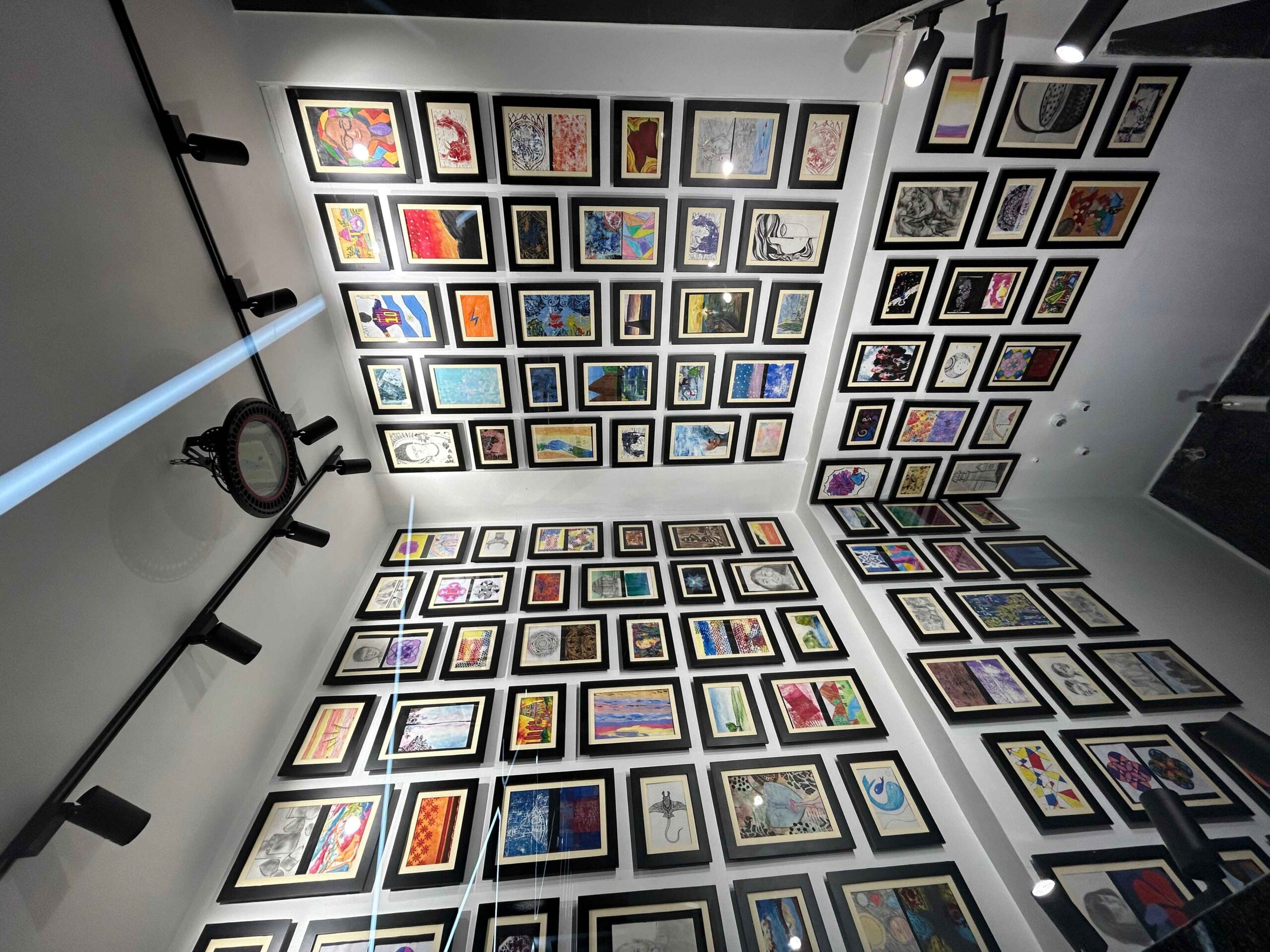
Upon entering the Palavakkam campus of aLphabet internationaL schooL, as one walks towards the classrooms they would come across a new companion to the fish tank, adorning the walls in the alcove: a gallery of over 150 artworks by our very own students.

The school feels pride in showcasing the artist present in its students quite like the pride felt by the parents who display the artworks of their children on refrigerators or their workplaces.

We at aLphabet internationaL, one of the leading IB schools in Chennai, spare no opportunity for providing a platform for kids to showcase their creativity. The gallery is an attempt at making students feel at home and feel seen, their artworks being given the deserved recognition. The goal is to exhibit to the wider community the various kinds of art that students are producing.

The gallery includes artworks by students of all grade levels. While the artworks were made for various assessments and units included in their curriculum, the art display is an extension of that, taking the idea of art as an integral part of education to the public. It showcases the IB focus on formal study of art which encourages students to find their voice. Most of the art assignments are open-ended with a few guidelines to help students navigate through a myriad of ideas. The aim is to create a structured space for exploration and experimentation. Not just as formal education, art is also integrated into learning in the curriculum to help PYP students learn to express themselves using different modes of communication and show their understanding of various concepts.

The artworks displayed cover a wide range of ideas and art techniques. From canvases, pencil sketches, portraits, landscapes, glass paintings, prints, to creative works about how the students view themselves, the places they’ve visited, and many more, the gallery presents a plethora of free-flowing ideas.

The art gallery at aLphabet internationaL school thus stands not only as a testament of the creativity and expression of its students but also as a vibrant showcase of the school’s commitment to nurturing artistic talent and integrating art into its educational fabric. By providing a platform that celebrates over 150 artworks across various media and themes, the school fosters a sense of pride and recognition among students, encouraging them to explore and express themselves freely. Through this initiative, aLphabet internationaL underscores the importance of art as a fundamental aspect of education, enriching the learning experience and empowering students to find their unique voices.

The Beginning of the Journey towards Greatness


A Glimpse into what one of the Best International Schools in Chennai Offers You

Entering a new school can be both intimidating and exciting. Adjusting to a new environment, meeting new people, and learning new ways of doing things can be challenging. We want to make your transition as smooth as possible. Here, at aLphabet internationaL schooL, the doors of opportunities are wide open for everyone.

We are committed to creating a well-rounded environment for students to grow in all areas of their lives. This is accomplished through fostering strong student-teacher relationships, tailoring learning experiences to each student’s specific needs, fostering a sense of community and social awareness, promoting an appreciation for cultures from around the world, and ensuring a safe and welcoming environment for all students.

In addition to the academics, the school has dedicated avenues for students to enter into co-curricular and extra-curricular activities to build upon the classroom lessons through its praxis. We encourage students to actively participate in a wide range of activities designed to bring out the best in everyone, providing them with a platform to showcase their talents and interests, and let their passions take the form of creative expression.

Each grade level is designed to meet the needs of students in a particular age group, with an emphasis on fostering an appreciation for cultural diversity to prepare them to become global citizens. Our teaching methodologies form a transformative process leading to conceptual understanding, making education more impactful and meaningful. Our teachers practise continuous and rigorous learning to build an up-to-date curriculum for the students across all the years, breaking away from conventional teaching methods. In other words, they are life-long learners themselves, constantly learning from the diverse perspectives students bring, making learning a two-way street. The students’ conceptual learning is paired with a practical application of what they learn, making them adept at using their knowledge in real time and in unfamiliar situations.

One among the best IB schools in Chennai, our school is a safe haven for kids from all over the world to bring out their untapped values and be given the deserved acknowledgement. With a combination of appreciation and encouragement, the teachers become peers, bringing down the rigid boundaries between them, guiding the students in traversing the real world. The cultures around the world are given a space to collaborate and interact with each other, enlightening the children about the unity that can be enjoyed in the diversity.

As the students enter through the door of aLphabet internationaL schooL they would step into a world where there is no dearth of opportunities; and when they step out, they step out of their comfort zones as responsible individuals who are empathetic, confident, resourceful, and open-minded.

We wish you luck on this joyride of education. Welcome to aLphabet internationaL schooL.